
Monthly overview
CA-TPU stood at 120.47 in September 2026, up 18.51% from August and rising for a second consecutive month. The three-month moving average fell to 105.76. The rebound came primarily from media sources in Uzbekistan and Kazakhstan. Reporting related to trade and sanctions increased, but its content differed substantially across sources. In Uzbekistan, coverage of diplomatic cooperation and reviews of foreign media expanded. Kazakhstan's trade coverage included long articles on e-commerce and commentary on international economic relations. In Kyrgyzstan, sanctions discussions centered on addresses to the UN General Assembly and existing compliance measures.
The most notable development this month was broader coverage of trade issues, accompanied by higher keyword frequencies driven in part by a few long articles. The increase in the frequency of 'agreement' was concentrated in Uzbek media reviews. Discussion of 'sanctions' picked up while Kyrgyzstan's sub-index continued to fall. Article content and the distribution of reporting within the month indicate that the concentration of coverage around diplomatic events was relatively short-lived, whereas fuel supply and compliance issues persisted throughout the quarter.
1. The rebound came mainly from Uzbek and Kazakh media sources
The September index was 18.82 points above August. The increase in Uzbekistan's sub-index contributed approximately 15.31 points and Kazakhstan's approximately 5.94 points. Declines in Kyrgyzstan and Tajikistan together offset about 2.43 points. In August, the increase from Uzbek sources had primarily offset the decline from Kazakh sources. In September, both major source countries moved upward, producing a larger rebound in the regional index.
| Indicator | August | September | Month-on-month |
|---|---|---|---|
| CA-TPU | 101.65 | 120.47 | 18.51% |
| Kazakhstan | 33.01 | 43.40 | 31.48% |
| Uzbekistan | 220.69 | 268.12 | 21.49% |
| Kyrgyzstan | 108.96 | 91.33 | −16.18% |
| Tajikistan | 110.51 | 79.66 | −27.92% |
Country sub-indices compare changes over time within the same media-source country. Their absolute levels do not provide a ranking of country risk.
The sample contained 227 records with joint occurrences of keywords in all three categories, trade, policy, and uncertainty, in September, compared with the previously reported 191 in August. These joint-hit records represented 4.21% of records containing keywords in at least one category, up from 3.84%. The rebound therefore coincided with a higher proportion of joint-hit records, alongside the increase in the total volume of news. September contained 11,232 news records, of which 5,386 matched at least one keyword category.
Joint-hit records from Uzbek sources increased from 35 to 45. Within this total, UzA rose from 26 to 39, while Kun.uz declined from 9 to 6. The Uzbek increase was clearly concentrated in UzA. In Kazakhstan, both Kazinform and Forbes Kazakhstan recorded increases, reaching 76 and 37 joint-hit records, respectively, in September. Differences across outlets indicate that the regional rebound combined a broader increase in coverage with the expansion of a particular section in one outlet.
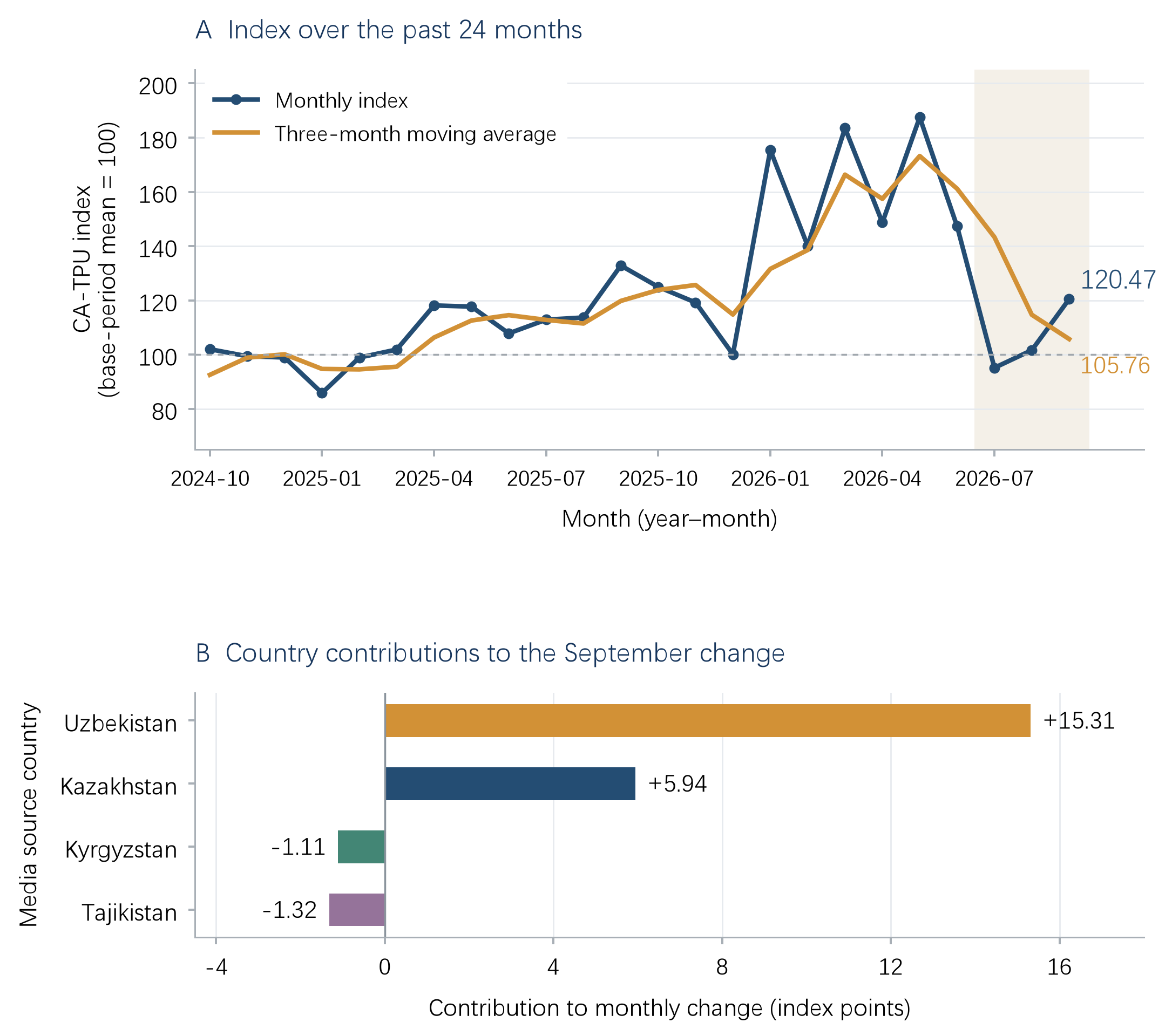
The upper panel shows the published index and its three-month moving average. The lower panel shows country contributions to the September increase, in index points.
The September index remained 9.31% below its year-earlier level, and the three-month moving average was 7.80% below August. The monthly increase and the decline in the moving average occurred together because June's higher reading of 147.33 left the three-month window, while September's 120.47 was insufficient to replace that level. Even after the rebound, the index remained below the elevated levels of the first half of the year.
2. Rising trade word frequency: broader coverage and the influence of long articles
| Keyword family | August frequency | September frequency | Change |
|---|---|---|---|
| Trade | 243 | 493 | +250 |
| Sanctions | 54 | 152 | +98 |
| Exports | 79 | 132 | +53 |
| Imports | 34 | 85 | +51 |
| тариф (tariffs or rates) | 31 | 69 | +38 |
| Duties or levies (пошлина) | 8 | 34 | +26 |
| Agreement | 145 | 168 | +23 |
| Contract or treaty | 117 | 85 | −32 |
| Law | 112 | 97 | −15 |
| Taxation | 11 | 27 | +16 |
Frequency counts occurrences of a keyword family within joint-hit records. Depending on the text, тариф can refer to customs tariffs, transport rates, or utility prices.
The 'trade' keyword family reached 493 occurrences, the largest increase. It appeared in 127 of September's joint-hit records. The increase came both from more records discussing trade and from dense repetition of trade-related words in some long articles. For example, two records containing the same September 8 article ranking Kazakhstan's e-commerce platforms accounted for 106 occurrences, or 21.5% of the month's 'trade' frequency. A long September 12 article on economic relations between Astana and New Delhi contained 21 occurrences, and September 25 commentary on China–US trade relations contained 18. The total thus combined e-commerce development, regional cooperation, and international trade policy.
Within the joint-hit sample, the Uzbek section reviewing world media coverage increased from 10 records in August to 20 in September, contributing 97 occurrences of 'trade' in September. These articles typically bring together diplomatic, investment, and social issues concerning Uzbekistan. Long reviews discuss trade, policy, and risk in the same text and therefore account for part of the joint-hit sample. The rise in Uzbekistan's sub-index includes the effects of concentrated diplomatic coverage and discussion of cooperation initiatives.
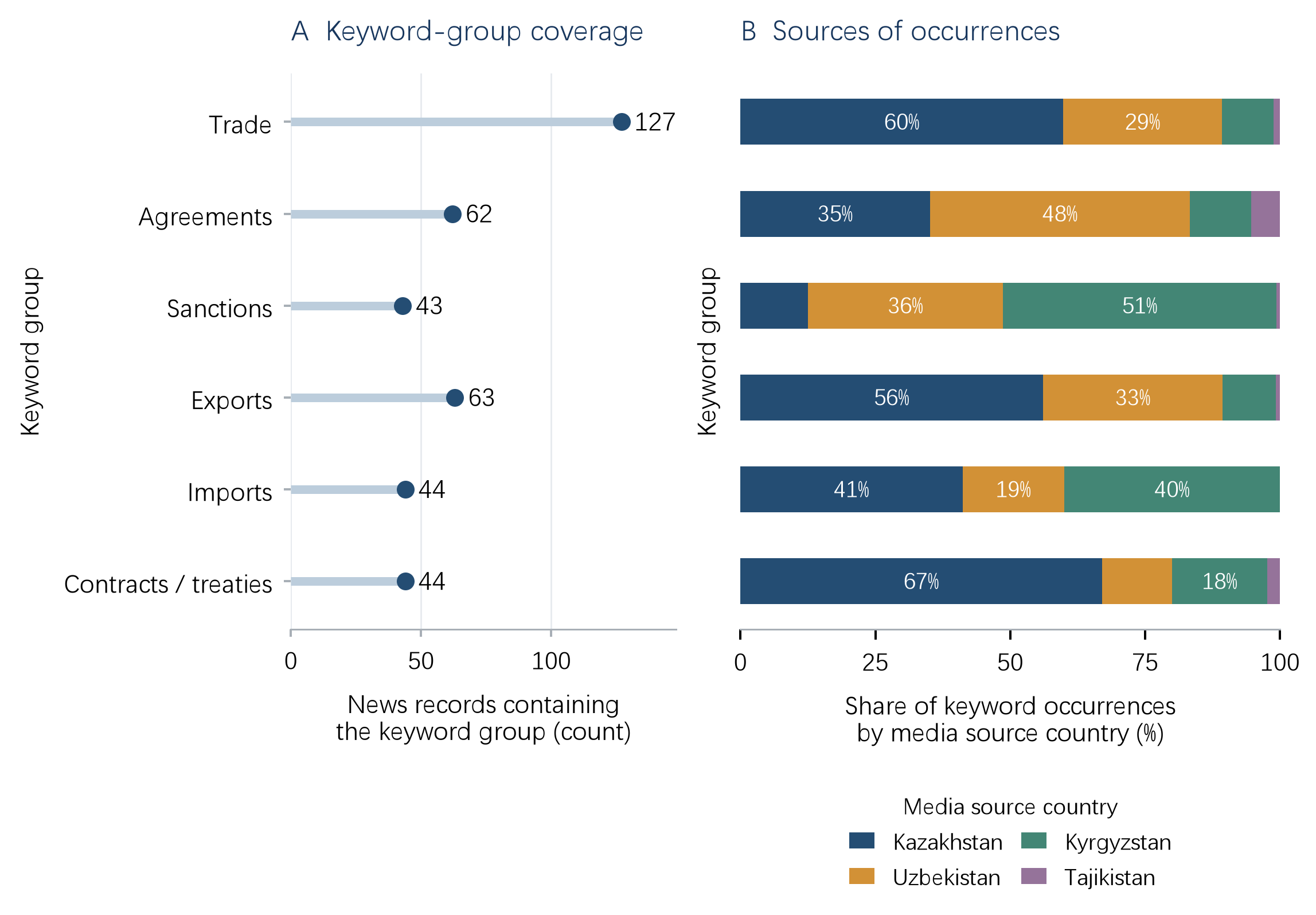
The left panel counts September joint-hit records containing each keyword family. The right panel shows the source composition of the corresponding word frequencies. Record counts measure coverage, while word frequencies measure repetition within texts.
The change in 'agreement' is particularly clear. Of its 168 occurrences in September, 81 came from Uzbek media, up from 26 in August. Kazakh sources declined from 68 to 59 and Kyrgyz sources from 47 to 19. The increase was concentrated in Uzbekistan. Four UzA reviews dated September 23, 24, and 28 contained 46 occurrences, accounting for 27.4% of the month's 'agreement' frequency. There were 62 September joint-hit records containing 'agreement'. Four reviews thus accounted for more than a quarter of all occurrences, demonstrating the substantial influence of a few long texts on the monthly total.
September produced mixed answers to August's question of whether discussion of agreements and contracts would continue to increase. 'Agreement' rose further, while 'contract or treaty' fell to 85 occurrences and 'law' declined from 112 to 97. Discussion of taxation and imports recovered from August's low levels. Less discussion of laws and contracts, alongside renewed attention to imports and taxation, produced a different mix of issues from August.
3. Renewed sanctions discussion centered on existing compliance issues and diplomatic statements
In September, 'sanctions' appeared 152 times across 43 joint-hit records. Kyrgyz media contributed 77 occurrences, Uzbek media 55, Kazakh media 19, and Tajik media 1. Kyrgyz sources were the main contributor, but 34 of their occurrences were concentrated in three September 22–23 reports on Japarov's address to the UN General Assembly, accounting for 44.2% of the Kyrgyz total. These diplomatic statements were an important reason for the concentration of sanctions discussion during the month.
Reporting on implementation continued the bank and corporate compliance issues already present in July and August. Two September 19 records about a common bank list and screening arrangements contributed 7 occurrences of 'sanctions'. The September 30 draft controls on dual-use items corresponded to only 1 joint-hit record. The draft received limited coverage during the month; its finalization and implementation warrant subsequent attention. September 28 reporting on the A7 network presented allegations from a media investigation, which should also be distinguished from regulatory measures already in force.
Kyrgyzstan's sub-index fell by 16.18% in September even as sanctions word frequency rose. Its joint-hit records declined from 65 to 61, while records matching at least one keyword category increased from 1,680 to 1,881. The joint-hit proportion consequently fell from 3.87% to 3.24%. Repeated references to sanctions in a few reports on speeches increased word frequency without a corresponding rise in the overall proportion of relevant records. September therefore saw greater attention to the sanctions topic alongside a lower joint-hit proportion in Kyrgyz sources.
4. Summit coverage and the within-month pattern: concentrated reporting without a sustained rise
The month's joint-hit sample included 12 records whose titles explicitly referred to the Shanghai Cooperation Organisation (SCO), mostly at the beginning of the month and across Kyrgyz, Uzbek, and Kazakh sources. The joint-hit proportion reached 5.12% in the week of August 31–September 6, then fell to 2.80% in September 7–13. Of the 60 joint-hit records in August 31–September 6, 11 explicitly referred to the SCO in their titles, a share of 18.3%; only 1 remained in the following week. The decline in summit coverage coincided with the fall in the weekly proportion, and the early-month peak did not persist.
Reporting on Central Asia–South Korea cooperation and related bilateral initiatives increased again in mid-September. There were 11 joint-hit records whose titles directly concerned cooperation with South Korea or Seoul: 5 from Uzbek sources and 6 from Kazakh sources. Of these, 10 appeared in September 14–20, accounting for 17.9% of that week's 56 joint-hit records. The joint-hit proportion recovered to 4.49%. The reports discussed industrial cooperation, critical minerals, and technology projects, as well as specific projects such as natural gas processing and commercial agreements. The wider cooperation agenda generated more discussion of trade. Records with SCO-related titles contained only 1 occurrence of 'agreement', and those with South Korea cooperation titles contained 7. Together, they accounted for 4.8% of the month's 168 occurrences. Diplomatic cooperation generated a group of trade reports, while high frequencies of 'agreement' were concentrated mainly in other articles.
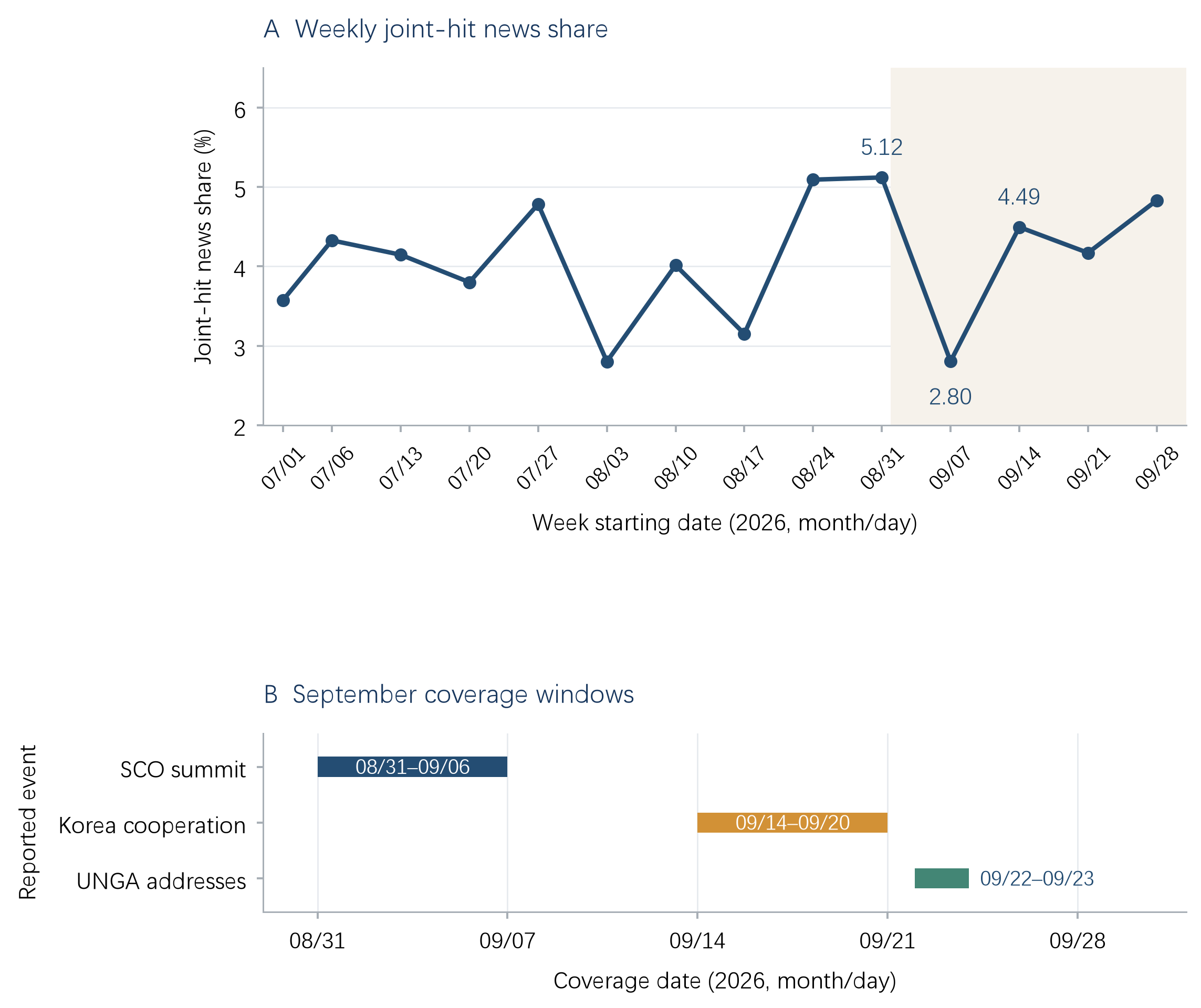
The line is the ratio of joint-hit records to records matching at least one keyword category. Event markers indicate when the relevant coverage appeared. The first and last weeks are incomplete; September 28–30 covers only 3 days.
Checking word meanings also changed the interpretation of increased discussion of 'tariffs'. September reports on heating price adjustments in Atyrau and heating prices in Petropavlovsk each contained 6 occurrences of тариф, together accounting for 17.4% of that keyword family's monthly frequency. Some uses of тариф in SCO coverage referred to transport rates. The separate duties and levies family, пошлина, increased from 8 to 34 occurrences; the September 25 commentary on China–US trade contained 8 of them and discussed international tariffs. The composition therefore includes both international tariff negotiations and local heating price adjustments. Heating prices directly affect living costs during the winter, an economic issue distinct from changes in border taxes.
5. October outlook: summit coverage will subside; implementation and supply warrant closer attention
We expect growth in trade word frequency to slow markedly in October. September's e-commerce ranking, summit coverage, and long media reviews created a high comparison base. Without new events on a similar scale, the increase generated by this concentration of texts will diminish. The next report should first assess whether coverage of trade continues to broaden and whether sources other than UzA reviews continue to increase, alongside total word frequency.
Sanctions issues in Kyrgyzstan will increasingly turn toward implementation details. Bank screening since July, the proposed initiation of corporate liquidation proceedings in August, and September's list arrangements form a continuing sequence. Subsequent developments of informational value will concern whether the list is implemented, how screening requirements are clarified, and whether the dual-use draft becomes a formal rule. New progress in these areas would make the reporting more directly relevant to transaction processing than coverage of the UN General Assembly address.
Fuel supply remains a more tangible operating constraint to monitor in the fourth quarter. During the quarter, reporting moved from tight supplies in July to procurement costs and the inflationary effects discussed in September. Fewer fuel-related titles in September did not establish that the problem had ended. Winter supply arrangements and procurement prices will determine whether the issue attracts concentrated coverage again. If new batches remain more expensive than existing stocks, restored supply may not bring an immediate decline in retail prices.
Companion materials
This report is accompanied by a data transparency and reproducibility package containing 22 CSV files of aggregate data, a data dictionary, figures in Chinese, English and Russian, and scripts for verification and plotting. Readers can use these materials to check the reported statistics and reproduce the figures from the aggregate data. The package is available for download alongside the report. Download the data transparency and reproducibility package.
About the CA-TPU index
CA-TPU (Central Asia Trade Policy Uncertainty Index) was developed by Professor Lijie Zhang’s team at the School of Economics and Management, Xinjiang University. Based on the economic policy uncertainty methodology of Baker, Bloom and Davis (2016), it covers major Russian-language media in Kazakhstan, Uzbekistan, Kyrgyzstan and Tajikistan. The index measures the intensity with which mainstream media in these four countries jointly discuss trade, policy and uncertainty. It uses 2015–2019 as the base period, with the base-period mean normalized to 100, and is released monthly. Full methodological documentation, historical data and reports in three languages are available at catpu.caiees.cn.
This report is a non-profit academic publication with independent funding. It does not constitute investment advice or a basis for commercial decisions. Attribution: CA-TPU Index Project.